
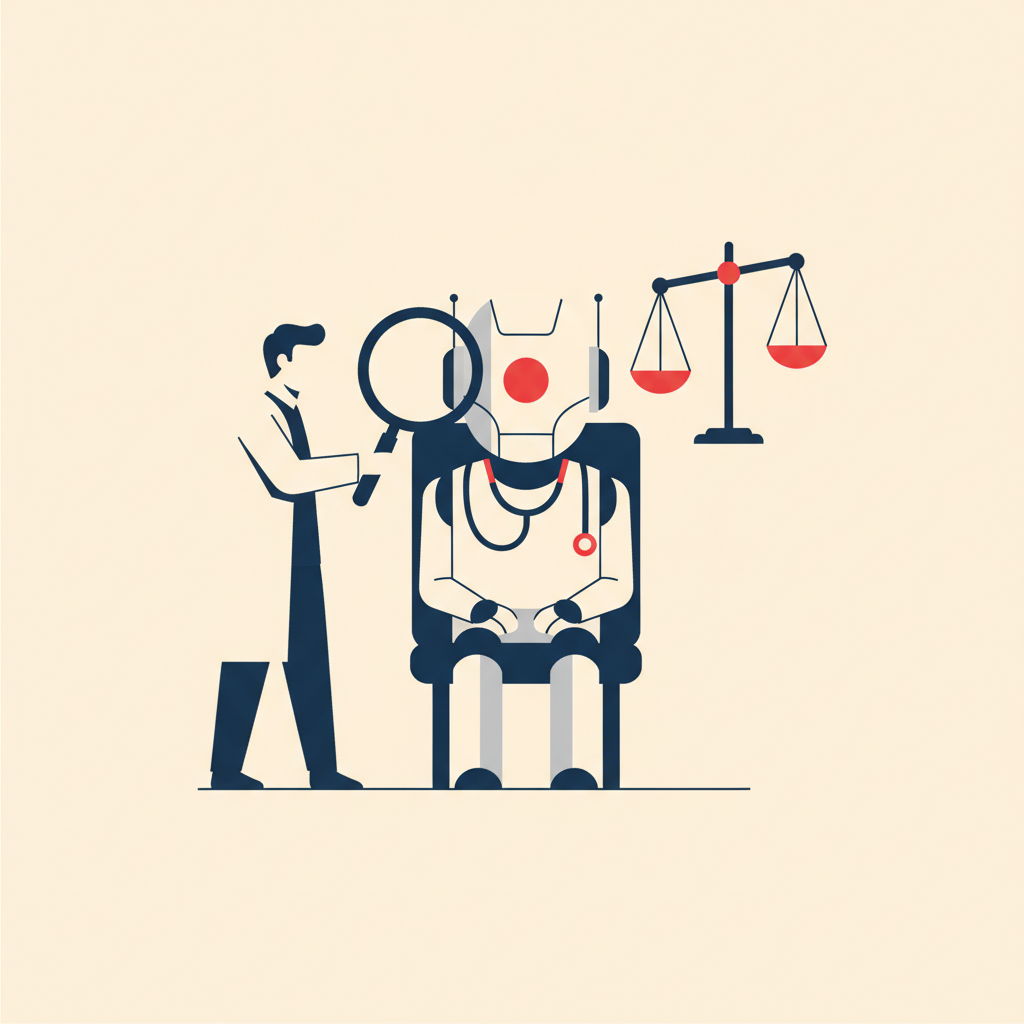
Why AI Assurance for Healthcare Is a Distinct Problem
AI assurance for healthcare sits at the intersection of two historically demanding domains: clinical safety and enterprise technology governance. Neither domain is forgiving on its own. Together, they create accountability pressures that most generic AI evaluation frameworks were not designed to handle.
The stakes are not abstract. Clinical AI systems inform medication dosing recommendations, flag sepsis risk, prioritize radiology queues, and — increasingly — initiate autonomous workflows without a human sign-off at every step. When a model degrades silently, the downstream consequences are not limited to a failed transaction or a miscalculated credit score. They touch patient outcomes. That difference in consequence is precisely why healthcare enterprises need an assurance posture that is fundamentally different from standard software QA.
This article is for the decision-makers responsible for that posture: heads of quality engineering, chief medical information officers, AI/ML leaders, and the compliance and risk officers who ultimately sign off on whether a clinical AI system is safe to operate.
What Makes Clinical AI Hard to Assure
Three characteristics make healthcare AI systems particularly difficult to evaluate and govern.
First, training data in healthcare is structurally biased. Patient populations in historical datasets often over-represent certain demographics, geographic regions, or care settings. A model trained on one hospital system's electronic health records may perform reliably in that environment and fail silently when deployed across a different patient mix. Assurance programs must include demographic subgroup analysis and ongoing performance stratification — not just aggregate accuracy metrics.
Second, clinical AI systems operate in high-stakes, low-tolerance environments. A fraud detection model in banking can tolerate a higher false-positive rate because the cost of a wrong call is manageable. In clinical settings, a false negative on a sepsis prediction model, or a false positive that leads to unnecessary intervention, can cause direct harm. Threshold calibration, uncertainty quantification, and escalation logic are therefore not optional components of model design — they are assurance requirements.
Third, model drift in healthcare is both common and dangerous. Patient populations change. Care protocols evolve. Coding practices shift. A model validated at deployment may degrade over months without triggering any obvious system alert. Continuous monitoring — not point-in-time validation — is the only defensible approach.
The Regulatory Landscape Is Tightening
Regulated healthcare enterprises cannot treat AI governance as a voluntary best practice. The regulatory environment has moved decisively toward mandatory requirements.
The EU AI Act classifies most clinical decision-support systems, diagnostic aids, and patient risk-scoring tools as high-risk AI. High-risk classification triggers a specific set of obligations: conformity assessments before deployment, comprehensive technical documentation, data governance requirements, human oversight mechanisms, and post-market monitoring. Organizations operating in EU jurisdictions — or marketing AI products to EU customers — need to be building these requirements into their development and procurement processes now.
ISO 42001, the international standard for AI management systems, provides a governance framework that maps closely to what healthcare compliance teams need: systematic risk assessment, defined accountability structures, and documented assurance processes. It is not a compliance checkbox — it is a management discipline.
📊 Related research
The State of AI Assurance in Healthcare 2026
A data-driven briefing for regulated healthcare enterprises on where AI governance, regulatory compliance, and assurance infrastructure stand today — and what budget-holders must do before the next enforcement cycle closes.
For enterprises operating in India, the Digital Personal Data Protection Act introduces data handling obligations that directly affect how patient data can be used in AI training and evaluation pipelines. The intersection of data protection law and AI assurance is not theoretical; it shapes what test datasets you can use, how long you can retain model inputs, and what consent frameworks must be in place.
Synthetic Data as an Assurance Enabler
One of the practical constraints that limits thorough AI testing in healthcare is access to representative test data. Real patient records are protected by multiple overlapping legal frameworks. The result is that many healthcare AI programs are tested on datasets that are too small, too narrow, or too similar to training data to surface real-world failure modes.
Synthetic patient data — generated to mirror the statistical properties of real populations without containing actual protected health information — is an increasingly credible solution. When generated with appropriate controls and validated against real distributions, synthetic data allows QE teams to stress-test models across edge cases, rare conditions, and underrepresented demographics that may not appear in available real-world test sets. It is not a replacement for clinical validation, but it is a powerful complement that extends testing coverage without creating compliance exposure.
Agentic AI Introduces New Assurance Challenges
Healthcare enterprises are beginning to deploy agentic AI systems — architectures where multiple models collaborate to complete multi-step tasks autonomously. Prior-authorization workflows, patient scheduling optimization, and clinical documentation assistance are early examples.
These systems are qualitatively harder to assure than single-model deployments. The failure modes are not just about individual model accuracy — they include emergent behaviors that arise from model interactions, error propagation across workflow steps, and the challenge of maintaining meaningful human oversight when the system is designed to minimize human touchpoints.
Assurance for agentic healthcare AI requires testing at the workflow level: evaluating whether the system's end-to-end behavior is safe and appropriate, not just whether each component model performs within its individual specification. This is a frontier discipline, and enterprises that deploy agentic clinical AI without a structured assurance program for it are accepting risks they may not yet have fully characterized.
Building an Assurance Program That Holds Up
A defensible AI assurance program for a healthcare enterprise has several non-negotiable components: continuous post-deployment monitoring with drift detection, bias evaluation across clinically relevant subgroups, adversarial testing for prompt injection and data poisoning in AI-assisted workflows, documented human oversight procedures, and a clear governance chain that connects technical evaluation findings to operational decision-making.
None of this is achievable through one-time validation. Healthcare AI assurance is a continuous discipline — not a gate at the end of a development cycle.
The enterprises that get this right will not just satisfy regulators. They will build the institutional capacity to deploy clinical AI at scale with genuine confidence in what it does and what it will not do. In a domain where patient safety is the ultimate accountability, that capacity is the only acceptable foundation.
In healthcare, a silent model failure isn't a bug report — it's a patient safety event. Assurance has to be built in from the start, not bolted on after deployment.
Go deeper — gated research
The State of AI Assurance in Healthcare 2026
A data-driven briefing for regulated healthcare enterprises on where AI governance, regulatory compliance, and assurance infrastructure stand today — and what budget-holders must do before the next enforcement cycle closes.