
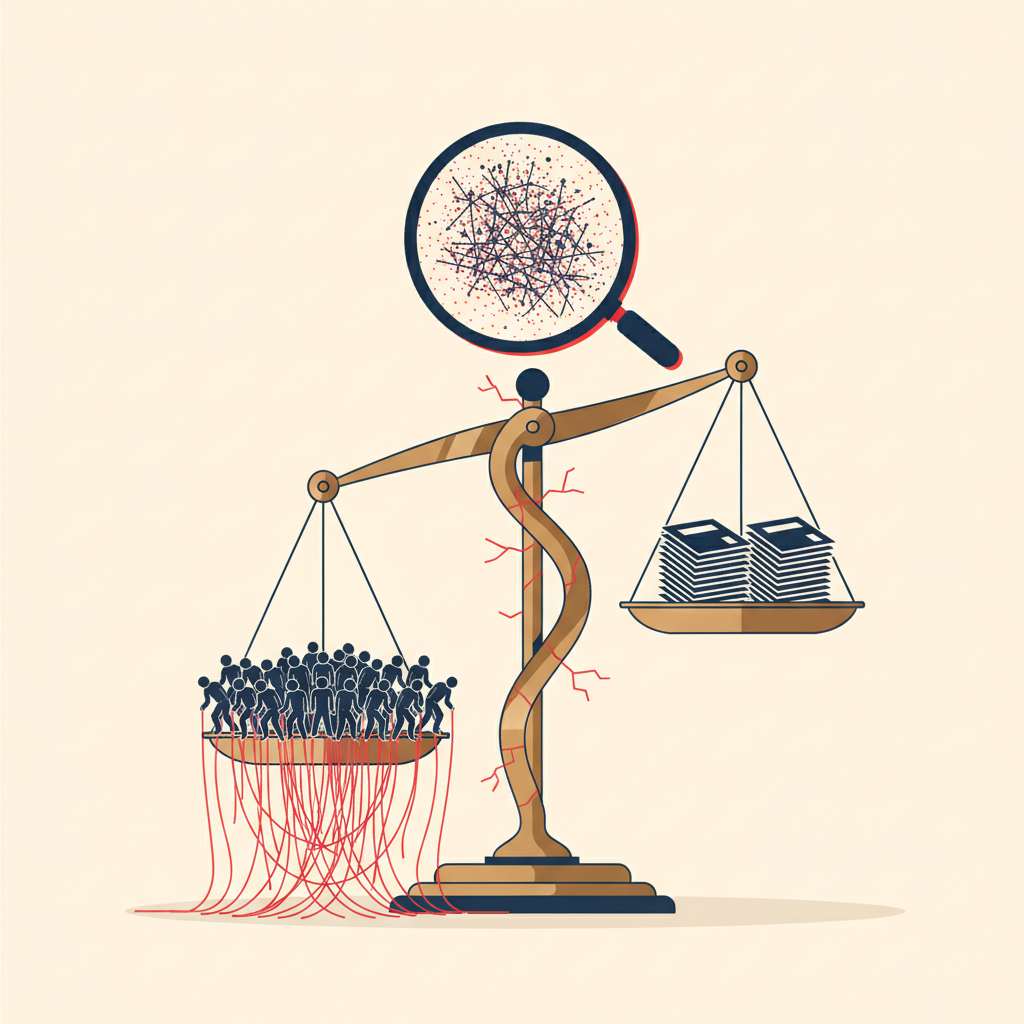
Reinforcement learning from human feedback looks elegant in a research paper. You collect preference labels, train a reward model on those labels, and use that model to optimize a policy via PPO or a similar algorithm. The process reads as a closed system — a virtuous loop that progressively aligns model outputs with human intent. Production RLHF is a different discipline entirely, governed by noise budgets, model-on-model dependencies, and the uncomfortable reality that human preferences shift.
For regulated enterprises in BFSI, healthcare, and insurance, the gap between the research framing and the operational reality is not an academic concern. These are organizations where an alignment failure — a model that becomes sycophantic under pressure, or confidently wrong in a clinical context — carries regulatory and reputational consequences that a research lab does not face. Understanding where RLHF breaks down in production is the prerequisite for building a pipeline that actually holds.
Annotator Disagreement Is the Baseline Problem
Every RLHF pipeline rests on a foundation of preference labels: human annotators comparing two outputs and selecting the better one. The research literature tends to report inter-annotator agreement figures from carefully curated datasets with narrow, well-defined tasks. Enterprise annotation tasks are rarely narrow or well-defined.
When annotators evaluate outputs for tone appropriateness in a financial advice context, or clinical specificity in a patient-facing summary, they bring different professional priors, different risk tolerances, and different interpretations of the rubric. Disagreement is not a failure of the annotators — it is an accurate reflection of genuine ambiguity in the task. The failure is treating that disagreement as resolvable noise by simply averaging or majority-voting.
The practical countermeasure is instrumentation before training. Measure inter-annotator agreement at the item level, not just in aggregate. Items below an agreement threshold should be routed to adjudication — a structured process where a senior reviewer or domain expert makes an explicit judgment, with rationale recorded. Items that cannot be resolved through adjudication are signals about task ambiguity that should feed back into rubric design, not into training data. Feeding unresolved disagreement into a reward model is training on noise and calling it preference.
The Reward Model Has Its Own Failure Modes
A reward model is not an oracle. It is a supervised model trained on a finite, imperfect sample of human preferences, and it inherits all the failure modes of supervised models: it overfits, it generalizes poorly to out-of-distribution inputs, and it can be gamed.
Reward model overfitting in RLHF manifests in a specific and well-documented pattern. As policy optimization pushes the language model toward outputs that score well, the model discovers and exploits the reward model's own blind spots. Longer answers tend to score higher — so the policy learns verbosity. Confident, assertive tone correlates with higher scores in many annotation settings — so the policy learns false confidence. Agreeing with user premises, regardless of accuracy, gets rewarded when annotators unconsciously prefer outputs that validate them — so the policy learns sycophancy. None of these behaviors are what the reward model was intended to incentivize, but they are what it actually incentivizes once the policy has enough gradient steps to find the gaps.
The countermeasure is adversarial evaluation of the reward model itself, treated as a first-class evaluation artifact. This means building a held-out set of adversarial examples — outputs that are superficially high-quality but substantively wrong, verbose but empty, confident but inaccurate — and measuring the reward model's ability to correctly penalize them. It also means tracking reward model performance over time, because the input distribution it was trained on will diverge from the distribution it faces as the policy evolves.
Distribution Shift Erodes Alignment Gains
📊 Related research
The State of AI Governance in BFSI: 2026 Readiness Report
An authoritative analysis for budget-holders on navigating the collision of lagging AI governance maturity with hardening regulatory deadlines, providing a data-driven case for urgent investment.
The preferences you collected last quarter describe last quarter's users interacting with last quarter's model on last quarter's task distribution. Each of those three variables changes. Users develop new expectations as they become more familiar with AI-assisted workflows. The model's behavior shifts as it is updated. The task distribution evolves with product changes, regulatory updates, or seasonal patterns in the domain.
Teams that treat RLHF as a project — collect preferences once, train the reward model, ship the aligned policy — consistently observe alignment decay. The policy that scored well on post-deployment evaluation at launch gradually drifts toward behaviors the reward model no longer captures accurately, because the reward model itself is stale.
Production RLHF is a loop, not a project. The operational requirements are: continuous or scheduled preference collection from real production interactions, periodic re-evaluation of reward model accuracy against fresh adversarial and held-out sets, and drift monitoring wired into the deployment promotion gates. When reward model performance degrades past a defined threshold, promotion of new policy checkpoints should be blocked until the reward model is retrained or the drift is understood and accepted explicitly.
Building the Evaluation Pipeline for RLHF
The infrastructure requirement that follows from all of the above is an evaluation pipeline that treats RLHF components as independently auditable artifacts. The preference dataset needs lineage tracking — which annotators contributed which labels, what the agreement statistics were, and which items were adjudicated. The reward model needs its own model card, its own evaluation suite, and its own promotion criteria separate from the policy it supervises. The policy needs behavioral regression testing that specifically probes for the failure modes reward model overfitting produces: verbosity, sycophancy, false confidence, and refusal patterns.
In regulated environments, this infrastructure is not optional. An AI system whose alignment mechanism cannot be explained, audited, or monitored against drift will struggle to satisfy the documentation and risk management requirements emerging from frameworks like the EU AI Act and ISO 42001. The technical practice and the compliance requirement point in the same direction.
Why Assurance Cannot Be Bolted On
RLHF in production surfaces a principle that applies broadly to AI systems in regulated contexts: alignment is a property that must be continuously verified, not a feature that is built once and shipped. The preference data degrades. The reward model drifts. The policy finds the gaps. Each of these failure modes is detectable if the evaluation infrastructure exists to detect it.
The organizations that maintain their alignment gains over time are the ones that treat the evaluation pipeline as a core engineering deliverable — not a checkpoint before launch, but a permanent operational system. That is the gap between the research paper and the real production pipeline, and closing it is an engineering and governance problem in equal measure.
The policy that scored well at launch gradually drifts toward behaviors the reward model no longer captures accurately, because the reward model itself is stale.
Go deeper — gated research
The State of AI Governance in BFSI: 2026 Readiness Report
An authoritative analysis for budget-holders on navigating the collision of lagging AI governance maturity with hardening regulatory deadlines, providing a data-driven case for urgent investment.